
In the 1890s, Liberica was going to save coffee.
Coffee leaf rust, Hemileia vastatrix, had swept through Asia and destroyed the Arabica plantations of Ceylon and Java. Planters and colonial botanists were desperate for a resistant species, and Coffea liberica — native to Liberia and the forests of western and central Africa — looked like the answer. It shrugged off rust. It handled lowland heat. It grew vigorously in exactly the conditions that killed Arabica.
It was planted across Southeast Asia at scale. In the Philippines it became kapeng barako and a point of national pride. In Malaya, Indonesia and Indochina it went into the ground by the thousands of hectares. For about two decades it looked like the future.
Then Robusta arrived, and Liberica lost on essentially every practical measure that mattered to a planter.
Why it lost
The tree is too tall. Left alone, Liberica reaches fifteen to eighteen metres — more forest tree than orchard crop. Arabica and Robusta can be kept at picking height with routine pruning. Liberica fights back.
The yields are low. For the space and the labour it occupies, it produces less.
The ripening is uneven. Cherries on the same branch ripen at meaningfully different times, which means more picking passes for less cherry.
The beans break the machinery. This is the underrated one. Liberica beans are large, asymmetric and irregular, with a thick tough husk. Every piece of equipment in the coffee supply chain — hullers, screen graders, density sorters, colour sorters — is built around the size and shape distribution of Arabica and Robusta. Liberica jams it, or needs its own dedicated line for a fraction of the volume.
Robusta did the same job better. It was also rust-resistant, also lowland-tolerant, yielded far more, and milled like ordinary coffee.
By the 1920s Liberica was in retreat almost everywhere. It has never come back.
Where it survived
Not through planning. Through inertia, and through the household.
The places Liberica persisted are places where the trees were on family plots rather than plantations — where nobody had a commercial reason to pull out a producing tree the household actually drank from. The Philippines kept a real barako culture. Malaysia has pockets. And Vietnam, where it arrived under French administration around 1900 as one more rust-resistant candidate, kept old stands in provinces like Quảng Trị.
Vietnamese named it cà phê mít — jackfruit coffee — for the tree, whose big glossy leaves genuinely resemble a jackfruit tree's. The name turned out to describe the cup as well.
Many of the trees still in production are forty years old and older. They were not preserved as heritage. They were simply never removed.
What is actually in the cup
Liberica does not taste like a variation on coffee you know. It tastes like a different thing.
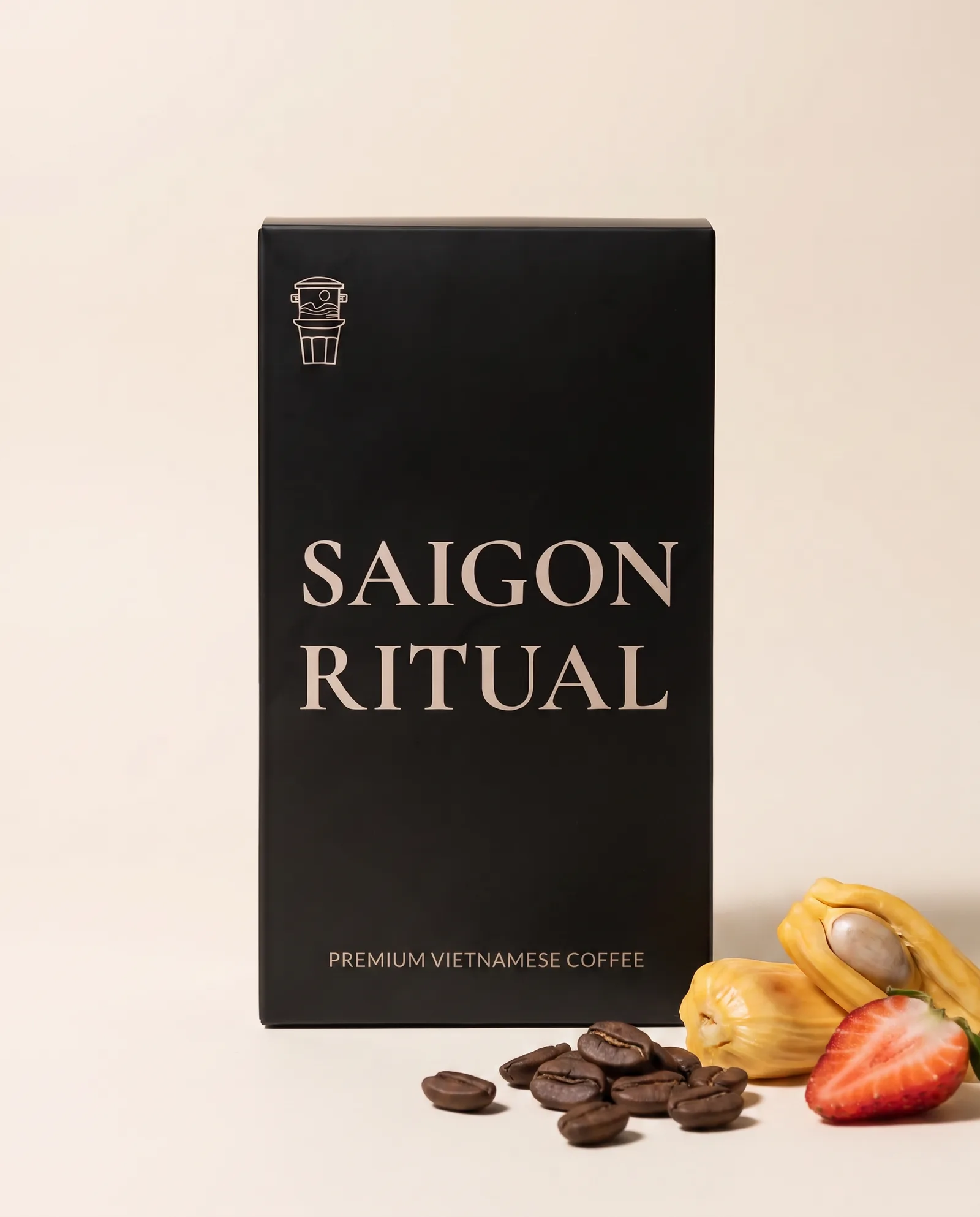
Jackfruit, immediately and unmistakably. This is not a stretch — the fruit ester profile genuinely overlaps, and the chemistry is worth reading.
Molasses. Dark, unrefined sugar rather than caramel.
Strawberry or red fruit on the finish, which surprises people.
A syrupy body heavier than Robusta, which is already heavy.
Low acidity and low caffeine — around 1.2% or below, the lowest of the three species.
First-time drinkers frequently say it does not taste like coffee. That is a fair report, and it is the appeal rather than the problem.
Is it good, or just rare?
A fair question, because rarity sells and the coffee world is not immune to selling it.
The honest answer: it is genuinely distinctive, genuinely good when well processed, and would still be a small crop even if everyone loved it, because the agronomy caps it. Our own Quảng Trị lot cups 84.62 on the Fine Robusta protocol — solidly specialty, and useful precisely because it is a normal number rather than a spectacular one. This is a good coffee that also happens to be rare, not a novelty coasting on strangeness.
It is also badly served by bad processing. The species tolerates heat and neglect in the field, which historically meant it got both, and much of what little Liberica reaches the market has been dried on the ground and roasted dark. Careful anaerobic-natural processing is what makes the fruit legible instead of merely funky.
How to drink it
Do not treat it like Arabica. The acidity is not there and looking for it will only disappoint.
Treat it like what it is: a heavy, sweet, fruit-forward coffee with an unusual profile. It takes well to immersion methods that flatter body, it makes a startling cold brew, and it is surprisingly rewarding as a pour-over if you go coarser and cooler than instinct suggests.
Drink it black at least once before you add anything. The jackfruit is the whole point, and milk buries it.
The larger point
Liberica is a reminder that what survives in agriculture is not what tastes best. It is what fits the machines, the shipping, the grading standards and the market.
Liberica failed those tests a century ago and was almost erased for it. That it survived at all is because a few thousand households kept drinking from trees the market had written off — which is, when you think about it, the same reason any interesting food survives.