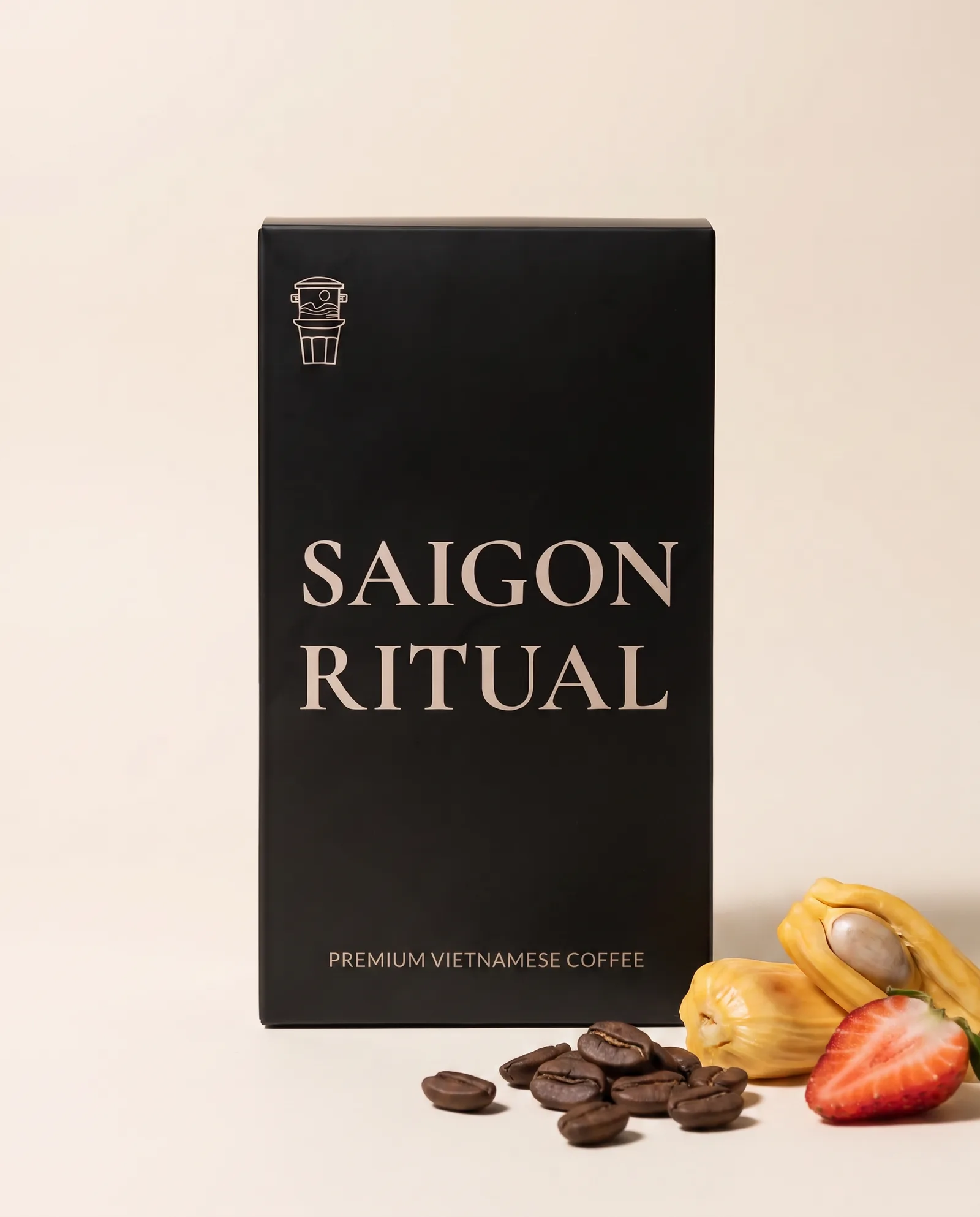

Vietnamese has called Coffea liberica cà phê mít — jackfruit coffee — for a century.
The usual explanation is that the tree's leaves look like a jackfruit tree's, which is true. Liberica has large, thick, glossy leaves, quite unlike the smaller leaves of Arabica or Robusta, and Vietnamese named all three species after leaf resemblances: cà phê chè (tea) for Arabica, cà phê vối for Robusta, cà phê mít for Liberica.
But the name turns out to work twice, because Liberica also tastes like jackfruit. That part is not a coincidence anyone planned, and it has a chemical explanation.
Jackfruit's aroma, chemically
Jackfruit smells the way it does because of esters — a large family of compounds formed when an alcohol meets an organic acid. Esters are responsible for most fruit aromas in nature, and different combinations give different fruits.
The compounds that dominate ripe jackfruit aroma are short-chain ethyl and isoamyl esters. Isoamyl isovalerate is a major contributor. Ethyl butanoate, ethyl isovalerate and isoamyl acetate are all present and significant. Together they give jackfruit its particular signature: tropical, sweet, slightly fermented, a little musky, and quite unlike a citrus or a berry.
Liberica's aroma, chemically
Liberica has a distinctly different volatile profile from the other two commercial species, and the difference is not subtle in the lab or in the cup.
What stands out is how ester-rich it is, and specifically that it is rich in the same short-chain ethyl and isoamyl esters that carry jackfruit. Analyses of Liberica consistently find a fruitier, more ester-dominated profile than Arabica or Robusta, whose aromatics skew more heavily toward roast-derived compounds — pyrazines, furans, phenols.
So the perceptual overlap is not a trained imagination reaching for a familiar reference. The two things share a chemical family in a fairly specific way, and a nose that knows jackfruit finds it immediately.
There is a second contribution. Liberica cherries have an unusually thick, dense fruit layer relative to bean size. More fruit against the seed during natural drying means more fruit-derived compounds migrating in, and more substrate for fermentation to work on. The species is set up to end up fruity.
What processing adds
The anaerobic natural processing used on our Quảng Trị lot compounds this rather than fighting it.
Sealed-tank fermentation favours yeasts and lactic acid bacteria, and yeast fermentation produces ethanol. Ethanol plus the organic acids already present is precisely the reaction that makes ethyl esters. So an anaerobic ferment on a species already rich in ethyl esters produces more of exactly the compounds that read as jackfruit.
This is why badly processed Liberica is a disappointment. Dried on the ground, roasted dark, the fruit character is either never developed or roasted straight off, and what remains is a heavy, woody cup that justifies nobody's curiosity. The species needs careful processing to say what it has to say.
The rest of the profile
Jackfruit is the headline. The rest of the cup is worth naming too.
Molasses, not caramel. Darker, more mineral, closer to unrefined sugar. Distinct from the caramel sweetness of a honey-processed Robusta.
Strawberry or red fruit on the finish, which genuinely surprises people and appears to come from a different ester group again.
Syrupy body. Heavier than Robusta, which is already the heavy one. Liberica coats the palate in a way that has more in common with a liqueur than with filter coffee.
Low acidity, low caffeine. Around 1.2% caffeine or less, the lowest of the three species. It is a strong-tasting coffee that is not a strong coffee.
A savoury undertone that develops as the cup cools, faintly smoky, and one of the more interesting things about drinking it slowly.
Tasting the jackfruit deliberately
If you want to catch it clearly:
Smell the dry grounds first. The jackfruit is often loudest before water is added.
Brew it black, and let it cool. Volatile esters read differently across the temperature range, and Liberica opens up considerably as it drops from hot to warm. Most people who miss the jackfruit drank it too hot and too fast.
Do not add condensed milk on the first cup. Milk sugar buries the fruit entirely. It is a fine drink afterwards; it is the wrong first experiment.
Cup it against a Robusta. Side by side the difference is unmissable, and it makes the ester character legible in a way that a solo cup does not. The comparison guide sets up the exercise.
A note on the name
There is something satisfying about the fact that Vietnamese farmers named this tree after its leaves a century ago, and that gas chromatography later confirmed the cup deserved the same name for entirely different reasons.
That is usually how folk taxonomy goes. People who handle a plant every day for generations tend to be right about it, even when the reason they give is not the reason the laboratory finds.