
Quảng Trị is a narrow province on Vietnam's central coast, about fifty kilometres from the South China Sea to the Laos border. It sits immediately south of the 17th parallel, which means it sat immediately south of the Demilitarised Zone.
It is not on most maps of Vietnamese coffee. It should be, because it is where the Liberica is.
The ground
Quảng Trị is not the Central Highlands and does not pretend to be. There is no deep red basalt plateau here. What there is instead:
Coastal influence. Ocean air moderates the temperature range. Days are less brutal, nights are less cold, and the whole ripening cycle slows down. Slow ripening is one of the things altitude usually buys you; here the sea buys some of it instead.
Mineral soil. Weathered, mineral-rich, shallower than basalt. Different mineral profile, different cup.
Low elevation. Four hundred to seven hundred metres. Arabica struggles here — too warm, too humid, too much rust pressure. Robusta grows. And Liberica thrives, because Liberica is the species that actually wants lowland heat.
Why the trees are old
Coffea liberica arrived in Vietnam around the turn of the twentieth century, introduced by French administration alongside Robusta as a rust-resistant alternative to the Arabica that kept failing. It was planted widely enough to earn a Vietnamese name — cà phê mít, jackfruit coffee, for the tree's enormous leaves.
Then it lost. Robusta yields more per hectare, ripens more evenly, has smaller and more uniform beans that mill and sort more easily, and found an export market. Liberica has huge irregular beans that jam standard equipment, an inconvenient thick husk, uneven ripening, and low yields. Commercially, it was a dead end, and almost everywhere it was replaced.
Almost. On family plots in provinces like Quảng Trị, the trees stayed — not as a commercial strategy but because nobody had a reason to pull out a producing tree that the household drank from. Many of the trees in production today are forty years old and older. Liberica grows tall, up to eighteen metres if left alone, which is another reason it fell out of favour and another reason the survivors are distinctive.
The war, and after
The DMZ ran along the Bến Hải river through the middle of the province. Quảng Trị absorbed some of the heaviest bombardment of the war, and the town of Quảng Trị itself was essentially destroyed in 1972.
The agricultural consequences did not end with the fighting. Unexploded ordnance remains a genuine constraint on land use across the province, and clearance work is ongoing decades later. Land that cannot be safely cleared cannot be mechanised, deep-ploughed or replanted at scale.
That history is part of why the farming here looks the way it does: small family plots, hand-picking, minimal intervention, old trees left in place. Practices that read as artisanal choices in a specialty context were, first, what was possible.
It is worth being straight about that rather than romanticising it. The result is a genuinely distinctive coffee. The route to it was not a lifestyle decision.
What it tastes like
Quảng Trị Liberica does not taste like Robusta and does not taste like Arabica. Anyone who tells you a coffee tastes like jackfruit is usually reaching. Here it is simply accurate.
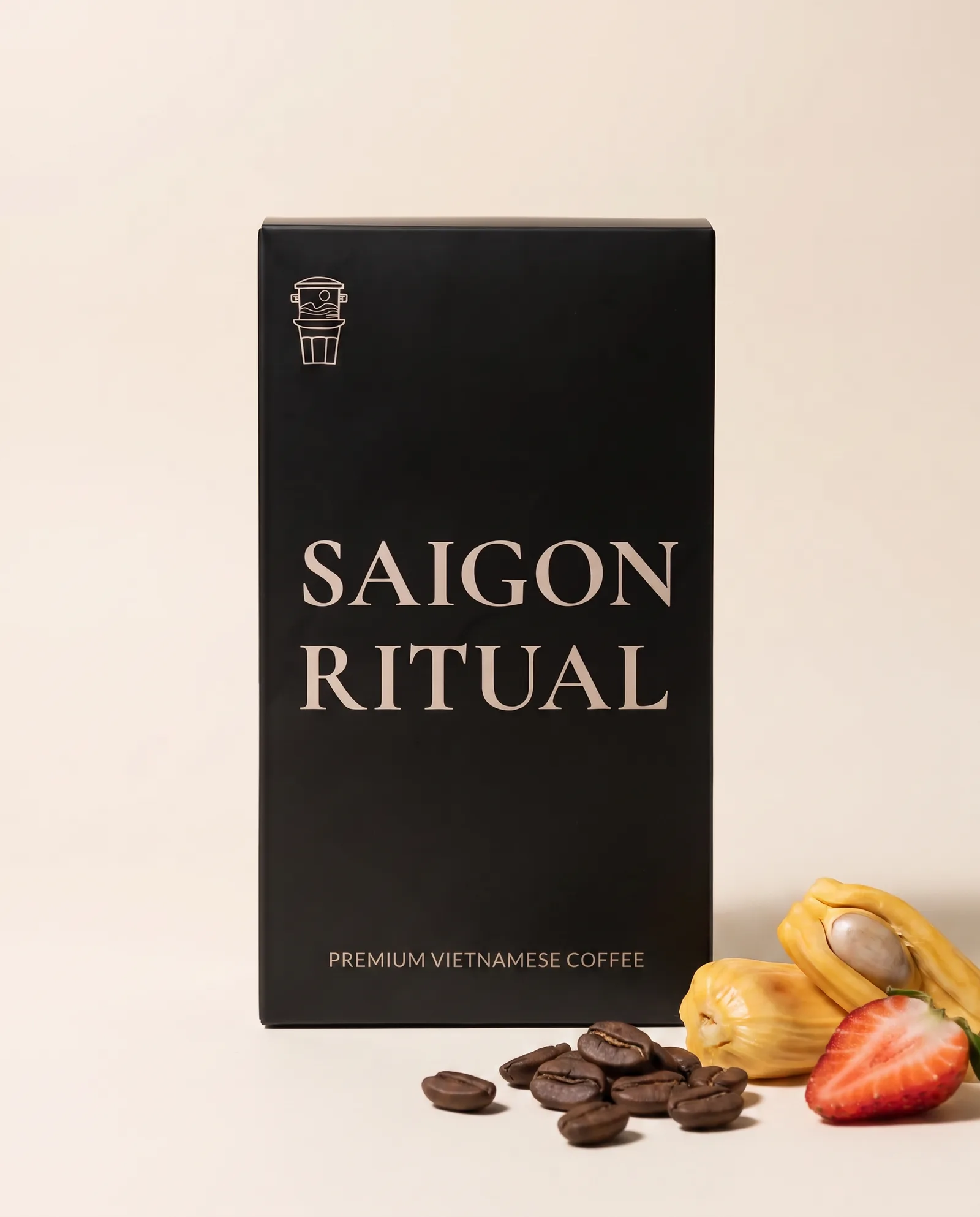
Jackfruit, first and unmistakably. Then molasses — a dark, unrefined sugar sweetness rather than caramel. Strawberry, oddly, on the finish. And a body that is genuinely syrupy, thicker than Robusta, which is saying something.
The chemistry behind the jackfruit note is more interesting than you would expect, and involves the fruit's ester profile rather than anything mystical about the terroir.
Our own Quảng Trị lot cups at 84.62 on the Fine Robusta protocol — comfortably specialty, and a useful number precisely because it is unremarkable. This is not a novelty scoring badly and selling on strangeness. It is a good coffee that also happens to be rare.
Scarcity, honestly stated
A partner farm here might produce five hundred kilograms in a harvest. One harvest a year.
That is not marketing scarcity. It is what a handful of hectares of forty-year-old low-yield trees, hand-picked and sun-dried, actually produces. When a year's lot is gone, it is gone until the next harvest.
The upside of that constraint is that everything about this coffee is traceable by default. There is no collector pooling it with anyone else's, because there is not enough of it to pool.
What it means for the province
Liberica will never be a volume crop, in Quảng Trị or anywhere. That is the whole point.
What it can be is a high-value one — a coffee where the price reflects rarity and quality rather than a futures screen, on land that cannot support industrial agriculture anyway. For a province with Quảng Trị's constraints, a low-volume high-value crop on old trees is not a consolation prize. It is close to the ideal fit.